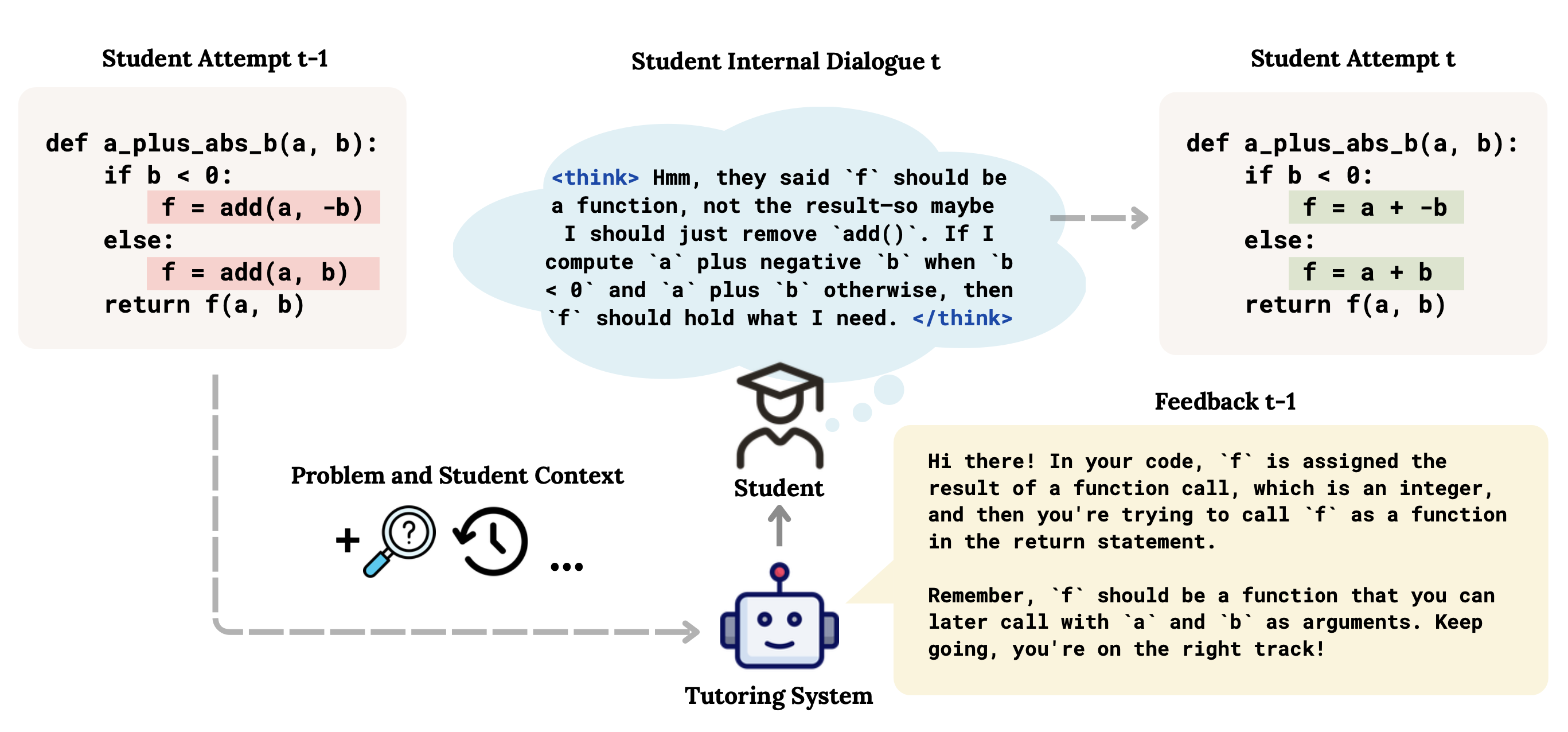
add(), but still misses that f should be a function.
Jointly Modeling Latent Reasoning and Action in LLM Student Simulators
University of California, Berkeley
Modeling the reasoning that leads to action makes student simulators more faithful and explainable.
add(), but still misses that f should be a function.
Large Language Model (LLM)-based simulators often reproduce observable actions but fail to capture the underlying reasoning behind them. In education, where student simulation is increasingly used for various applications such as evaluating tutoring systems, this gap is especially pronounced. Two students may submit identical submissions for entirely different reasons. We present Internal Student Dialogue (INSIDE), a student modeling framework that fine-tunes LLMs not only to act like students but also to think like them. INSIDE generates internal dialogue grounded in Bloom’s Taxonomy across cognitive, affective, and action dimensions, and fine-tunes models on paired think traces and actions. We baseline against different prompting frameworks and evaluate on two axes: fidelity of simulated actions and quality of generated internal dialogue. Our evaluations show that INSIDE improves simulation fidelity in both action fidelity, matching code generation of real students, and reasoning alignment, achieving the highest alignment across models up to 57.9%.
In education, the reasoning behind a student's attempt is what matters for diagnosing misconceptions and giving targeted feedback. Yet most LLM-based student simulators learn to copy what students do, not why.
Two students may reach the same solution, or the same wrong answer, for entirely different reasons. Observable actions give only a partial view of cognition.
Work on LLM reasoning mostly targets correctness. Students make errors, hold misconceptions, and apply incomplete strategies, and a simulator has to capture that.
Prior simulators treat student behavior as a black box and only predict outcomes. A student model's key affordance is access to processes real students don't reveal.
INSIDE gives the simulator an explicit internal dialogue before each action, modeling how a student thinks, not just what they do.
We only observe what students do: attempt t−1, the AI tutor's feedback, and attempt t. GPT-5 works backward from these to reconstruct what the student was thinking, in two stages grounded in Bloom's Taxonomy.
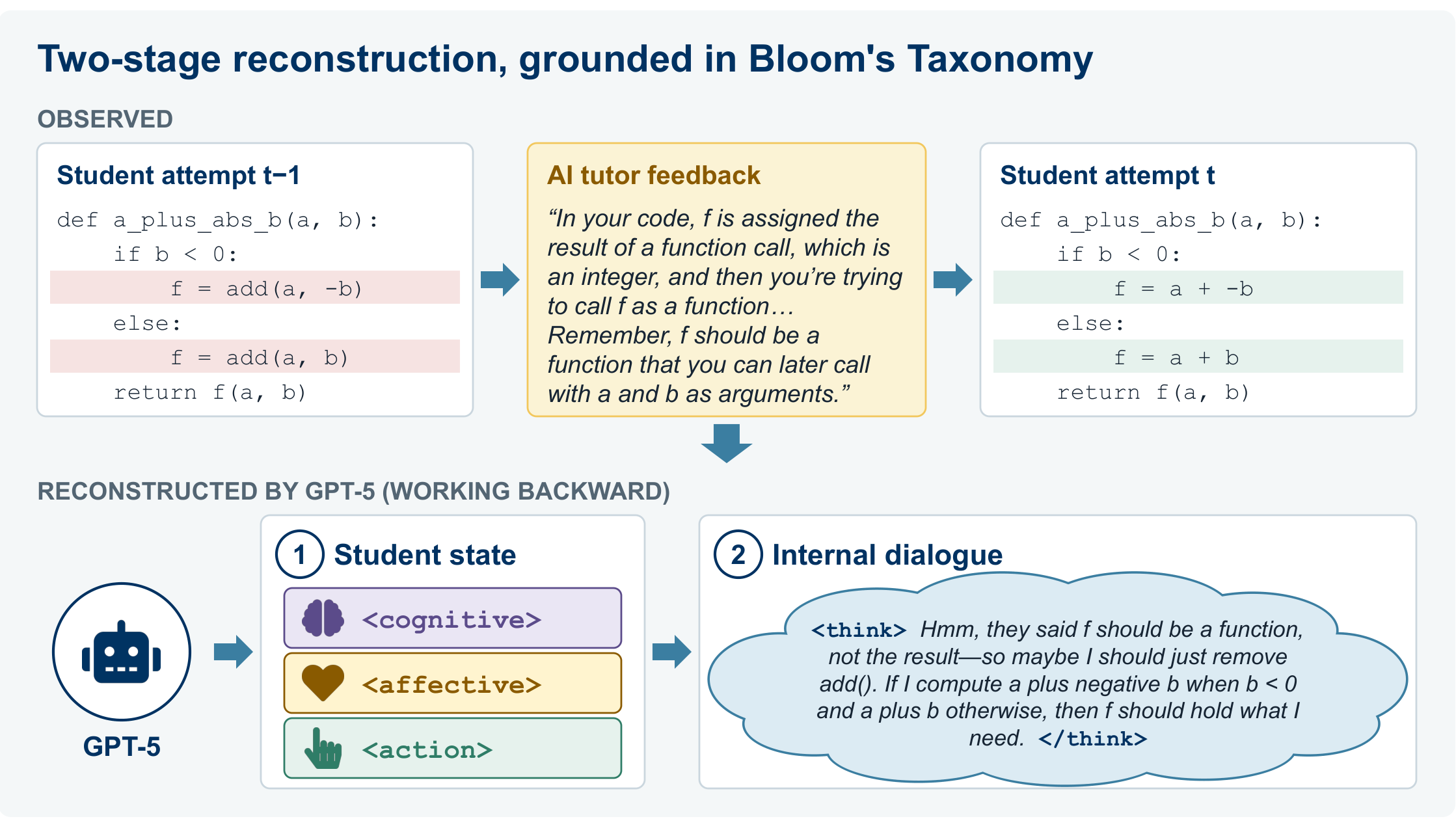
<cognitive> what the student understands or misunderstands, <affective> how they feel about it (confusion, frustration, confidence), and <action> the concrete programming step they take next.<think> monologue. When the edit is wrong, the misconception drives it and feels obviously right to the student.We use real submission–feedback streams from an intro programming course at UC Berkeley (~900 students per semester), covering the first five Python homework assignments. Students resubmit until all autograder tests pass, and failing submissions from students who opted in also get natural-language feedback from an AI tutor. Given the problem and up to 10 prior submissions with their feedback, the simulator predicts the student's next attempt.
We train on Spring 2025 (445 students, 6,911 submissions) and test on Spring 2024 (479 different students), split two ways: familiar problems that also appear in training (5,262 submissions), and new problems the model has never seen (1,054 submissions).
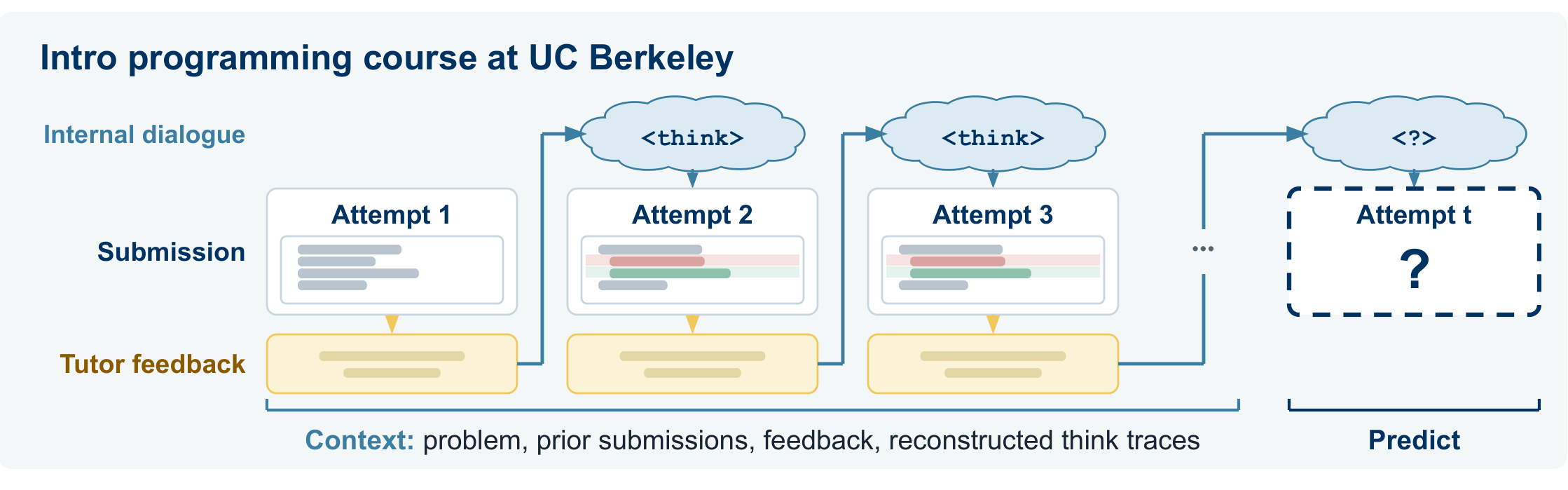
All methods receive the problem, prior submissions, and tutor feedback.
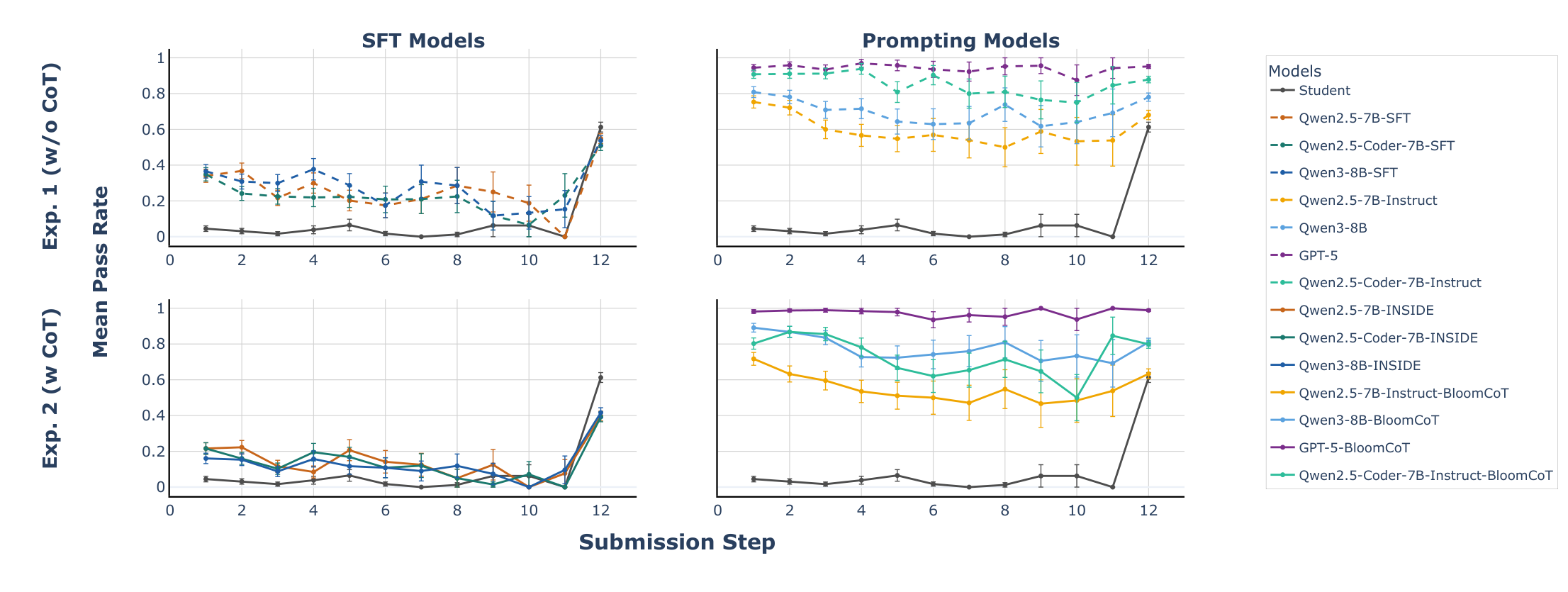
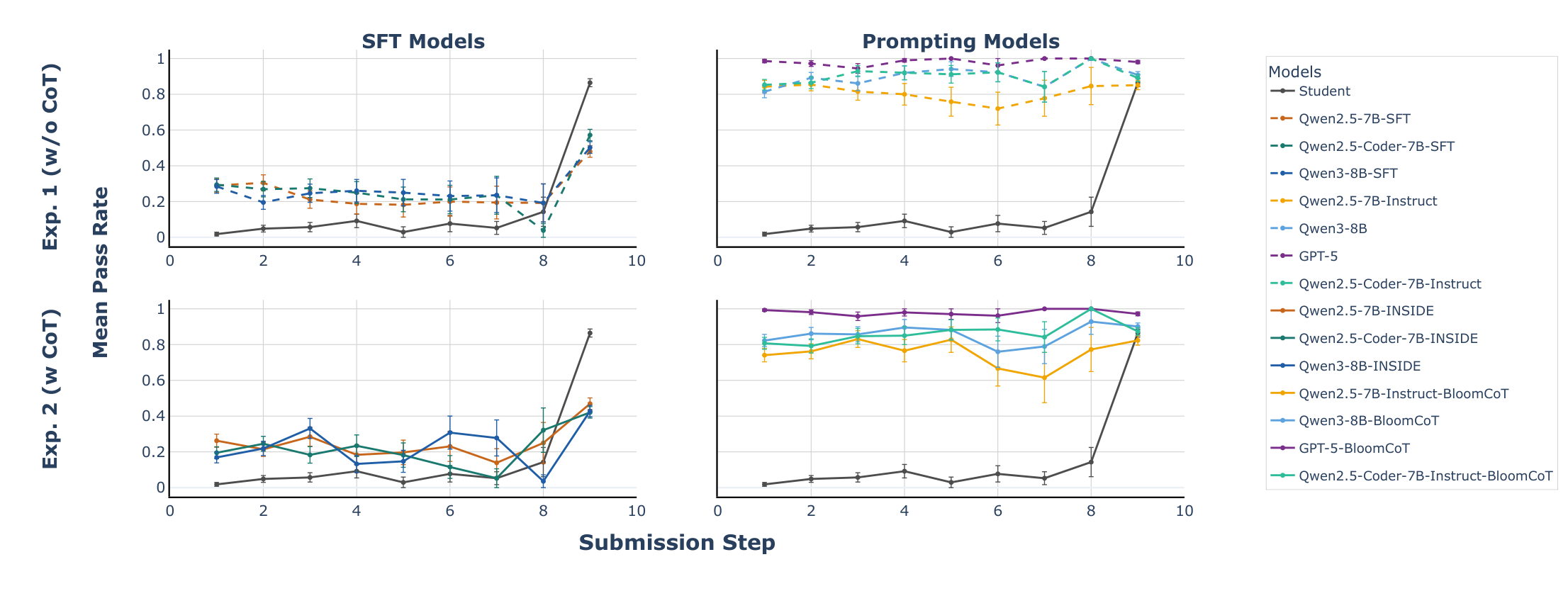
How close is the simulated action to the real one? For each code metric (pass rate, lines of code, AST depth, AST width, PEP 8 violations), we compute the Wasserstein distance W1 between the distributions of real and simulated submissions, estimated with 500 bootstrap resamples. Lower is closer to real students.
| Model | Pass rate | LOC | AST depth | AST width | PEP 8 |
|---|---|---|---|---|---|
| Prompted | |||||
| Qwen2.5-7B-Instruct | 0.39 | 0.71 | 0.60 | 0.98 | 1.12 |
| Qwen2.5-Coder-7B-Instruct | 0.46 | 0.80 | 0.68 | 1.78 | 1.13 |
| Qwen3-8B | 0.44 | 1.05 | 0.54 | 1.33 | 1.38 |
| Prompted + CoT | |||||
| Qwen2.5-7B-Instruct | 0.38 | 0.67 | 0.60 | 0.98 | 1.16 |
| Qwen2.5-Coder-7B-Instruct | 0.47 | 0.93 | 0.75 | 1.50 | 1.25 |
| Qwen3-8B | 0.48 | 1.08 | 0.59 | 1.46 | 1.38 |
| Prompted + BloomCoT | |||||
| Qwen2.5-7B-Instruct | 0.35 | 0.67 | 0.58 | 0.90 | 1.17 |
| Qwen2.5-Coder-7B-Instruct | 0.43 | 0.88 | 0.71 | 1.40 | 1.19 |
| Qwen3-8B | 0.47 | 0.98 | 0.54 | 1.30 | 1.37 |
| Fine-tuned (SFT) | |||||
| Qwen2.5-7B | 0.14 | 0.29 | 0.29 | 0.52 | 0.18 |
| Qwen2.5-Coder-7B | 0.15 | 0.29 | 0.29 | 0.51 | 0.19 |
| Qwen3-8B | 0.15 | 0.28 | 0.28 | 0.55 | 0.16 |
| INSIDE (ours) | |||||
| Qwen2.5-7B | 0.05 | 0.26 | 0.27 | 0.39 | 0.18 |
| Qwen2.5-Coder-7B | 0.05 | 0.21 | 0.21 | 0.40 | 0.16 |
| Qwen3-8B | 0.05 | 0.28 | 0.20 | 0.42 | 0.21 |
| Model | Pass rate | LOC | AST depth | AST width | PEP 8 |
|---|---|---|---|---|---|
| Prompted | |||||
| Qwen2.5-7B-Instruct | 0.37 | 0.86 | 0.50 | 1.05 | 0.82 |
| Qwen2.5-Coder-7B-Instruct | 0.45 | 0.85 | 0.52 | 0.71 | 1.01 |
| Qwen3-8B | 0.45 | 1.10 | 0.61 | 1.05 | 1.13 |
| Prompted + CoT | |||||
| Qwen2.5-7B-Instruct | 0.36 | 0.90 | 0.52 | 1.21 | 1.00 |
| Qwen2.5-Coder-7B-Instruct | 0.43 | 0.81 | 0.57 | 0.85 | 1.06 |
| Qwen3-8B | 0.44 | 1.06 | 0.74 | 1.37 | 1.21 |
| Prompted + BloomCoT | |||||
| Qwen2.5-7B-Instruct | 0.33 | 0.84 | 0.47 | 0.96 | 0.95 |
| Qwen2.5-Coder-7B-Instruct | 0.41 | 0.82 | 0.58 | 1.13 | 0.92 |
| Qwen3-8B | 0.42 | 1.01 | 0.68 | 1.19 | 1.18 |
| Fine-tuned (SFT) | |||||
| Qwen2.5-7B | 0.01 | 0.20 | 0.19 | 0.28 | 0.14 |
| Qwen2.5-Coder-7B | 0.03 | 0.35 | 0.18 | 0.39 | 0.16 |
| Qwen3-8B | 0.02 | 0.23 | 0.17 | 0.28 | 0.12 |
| INSIDE (ours) | |||||
| Qwen2.5-7B | 0.04 | 0.16 | 0.22 | 0.37 | 0.18 |
| Qwen2.5-Coder-7B | 0.05 | 0.20 | 0.18 | 0.14 | 0.19 |
| Qwen3-8B | 0.04 | 0.20 | 0.19 | 0.40 | 0.18 |
See Table 1 in the paper for the full table, including GPT-5.
Does the generated reasoning explain the real edit? We split each generated <think> into
claims and use an LLM judge (GPT-5-mini) to check whether each one is reflected in the student's actual edit from attempt
t−1 to t. Alignment is the fraction of claims that are. For example, 3 of 5 claims
reflected gives 60%.
Judge check: 95.2% alignment on teacher traces · 88% agreement with human labels (κ = 0.754)
| Model | Familiar problems | New problems | ||
|---|---|---|---|---|
| BloomCoT | INSIDE | BloomCoT | INSIDE | |
| Qwen2.5-7B | 49.6 | 51.8 +2.2 | 55.1 | 56.9 +1.8 |
| Qwen2.5-Coder-7B | 46.0 | 49.2 +3.2 | 51.3 | 55.5 +4.2 |
| Qwen3-8B | 47.9 | 50.5 +2.6 | 56.0 | 57.9 +1.9 |
See Table 2 in the paper for all models, including GPT-5, Qwen3-14B, and Qwen3-32B.
@inproceedings{niousha2026inside,
  title     = {{INSIDE} the Student's Mind: Jointly Modeling Latent Reasoning and Action in {LLM} Student Simulators},
  author    = {Niousha, Rose and Kang, Minwoo and Norouzi, Narges},
  booktitle = {Conference on Language Modeling (COLM)},
  year      = {2026}
}